
Unit 1 — Why There Is a Shape at All
- View
Part 1 — What this unit is for
Welcome. It is good to have you here, and it is worth saying at the outset that you are not behind.
A great many people sit through liturgical worship for years without ever being told what it is or where it came from. They pick up the postures by watching, learn the responses by repetition, and quietly assume that everybody else understands the parts they do not. Very often, everybody else is doing exactly the same thing. This is not anyone's fault. Liturgy was designed to be joined rather than studied, and for most of its history it was learned by standing next to somebody who already knew.
This unit gives you the thing that standing next to somebody cannot: the shape. Once you can see the shape, everything that happens inside it stops being a series of unexplained movements and becomes something you can follow.
We begin with the word liturgy itself, then with the oldest full description of Christian worship that has come down to us, and then with the two halves the whole thing is built from. After that we look honestly at why a church would use a fixed text at all, since that is a real question and deserves a real answer rather than a defensive one. Then we set out what the phrase “Western Rite” actually means. And finally we stand at the altar and ask why the person there is standing where they are standing.
Part 2 — Liturgy is a public work, not a private taste
The English word liturgy comes from the Greek leitourgia, and it did not begin as a religious word at all. In the ancient Greek cities it meant a public work: a duty undertaken by one person at their own cost for the benefit of the whole community. A wealthy citizen might fund a warship, or pay for a chorus at the festival, and that act of public service was his leitourgia. The word carries two ideas fused together — something done in public, and something done on behalf of others.
When the early Church took the word up, it kept both ideas and added a third. Christian liturgy is public, it is done on behalf of others, and it is Christ's own work before it is ours. The congregation does not generate the worship out of its own enthusiasm. It joins something already going on.
That is a small point with very large consequences, and it explains a great deal of what you are about to read. If worship is a public work rather than a private expression, then it will have a settled form, because public things do. It will not depend on how the minister happens to feel on the day. It will belong to the congregation rather than to the person leading it. And it will be recognisable to a stranger who has walked in off the street, because a public work is by definition something a stranger may join.
Hold on to that word: join. Almost everything in this course is an answer to the question of how a room full of people join a single act.
Part 3 — The oldest description we have
Around the year 155, a Christian teacher called Justin — later Justin Martyr — wrote a defence of the faith addressed to the Roman emperor. His purpose was to show that Christians were not the criminals and cannibals that rumour made them out to be, and so he did something no one had thought to do before. He described, plainly and in order, what actually happened when Christians met.
Strip his account to its bones and this is the shape. On the day called Sunday, everyone who lives in the town or the countryside gathers in one place. The writings of the apostles and the prophets are read aloud, for as long as time allows. When the reader has finished, the one presiding speaks, urging the congregation to imitate what they have heard. Then everyone stands and prays together. Bread is brought, and wine mixed with water. The one presiding offers prayers and thanksgivings, to the best of his ability, and the people give their assent by saying Amen. The deacons then distribute to each of those present, and carry a portion away to those who are absent. Afterwards, those who are willing and able give what they wish, and what is collected is used for orphans and widows, for those in want through sickness or any other cause, for prisoners, and for strangers staying among them.
Read that again slowly, and notice what is there.
Readings. A sermon. Prayers of the people. Bread and wine. A great prayer of thanksgiving. The congregation's Amen. Distribution. Communion carried to the absent. A collection for the poor.
That is not a rough ancestor of the liturgy you may have attended. That is the liturgy you may have attended, described eighteen and a half centuries ago, before there were church buildings, before there were vestments as we would recognise them, before a single one of the arguments that later divided the West. Everything in this course that looks elaborate was added to that frame. Nothing in this course replaced it.
It is worth being clear about what this does and does not prove. It does not prove that every detail of any modern rite is apostolic; a good deal of ceremonial developed much later, and this course will tell you when. What it does establish is that the structure is not a medieval invention or a nineteenth-century revival. It is very nearly as old as the Church, and it has proved remarkably difficult to improve upon.
Part 4 — Word and Sacrament: the two tables
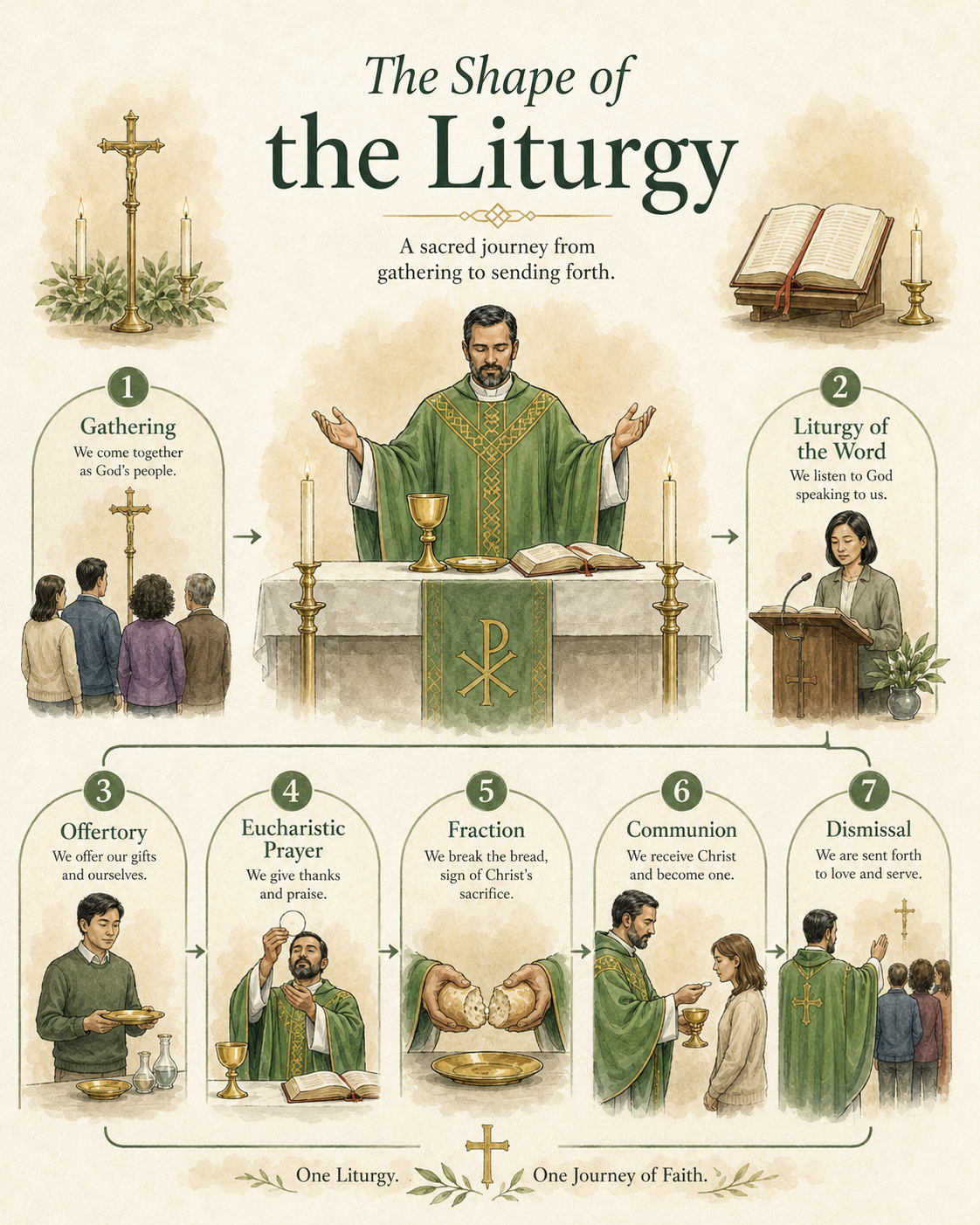
Figure 1 — The shape of the liturgy, from gathering to dismissal. The hinge this Part is about lies between stages two and three: that is where the Word ends and the Sacrament begins.
Look at Justin's account again and you will see it falls into two halves that join in the middle.
The first half is the Word. Scripture is read; it is explained; the congregation responds by praying for the Church and the world. The second half is the Sacrament. Bread and wine are brought, thanks is given over them, and they are shared. The two halves are not competitors, and neither is a warm-up for the other. The Church has often spoken of them as two tables at which the same congregation is fed — the table of the Word and the table of the Sacrament.
That image is not a modern kindness invented to make preaching feel important. It is exactly the pattern of the walk to Emmaus on the first Easter evening, where the risen Christ does both things in that order.
And it happened that, while he was at table with them, he took bread, and he blessed and broke it, and he extended it to them. And their eyes were opened, and they recognized him. And he vanished from their eyes.
Luke 24:30–31, Catholic Public Domain Version
The two travellers had already had the Scriptures opened to them on the road. Their eyes were opened at the breaking of the bread. Word first, then Sacrament — and the second of them is where they finally recognised Him. When Luke summarises the whole thing a few verses later, he does not say they recognised Him at supper. He says they recognised Him at the breaking of the bread, which was already, by the time he wrote, the ordinary name for the thing Christians did on Sundays.
The earliest summary of Christian life we possess puts the same four things in the same order.
Now they were persevering in the doctrine of the Apostles, and in the communion of the breaking of the bread, and in the prayers.
Acts 2:42, Catholic Public Domain Version
Teaching, fellowship, the breaking of the bread, the prayers. If you can hold those four in your head, you can find your place in almost any Western liturgy ever written, including ones that use unfamiliar words in an unfamiliar order.
A practical test you can use this Sunday
Ask yourself two questions during any liturgical service.
Where did the Word end? It is usually the moment the sermon finishes and the congregation is invited to profess the faith or to pray for others.
Where did the Sacrament begin? It is usually the moment bread and wine are physically brought to the altar and the table is set.
Find those two hinges and you will never be lost again, whatever the rite is called and whatever language it is in.
Part 5 — Why use a fixed text at all?
This deserves a straight answer, because it is the objection most often raised and most rarely addressed.
A fixed liturgy can look, from outside, like a failure of nerve — as though the Church did not trust anyone to pray freely and so wrote it all down in advance. Congregations that pray extempore sometimes say precisely this, and they are not being unkind when they do. They are describing what it honestly looks like.
Here is the case for the received text, put as strongly as it can be put.
A fixed liturgy protects the congregation from the minister. If the words are given, then the worship does not rise and fall with one person's eloquence, mood, theology, health, or grief. On the Sunday the priest is exhausted or bereaved or simply dull, the congregation still receives the whole faith of the Church, and receives it in good words. That is not a small mercy. It is a form of pastoral protection, and those who have lived under a gifted speaker's off years understand it immediately.
A fixed liturgy carries doctrine. What a church prays week after week is what its people will come to believe, far more reliably than what it prints in a doctrinal statement nobody reads. A settled text means the faith is taught continuously, by repetition, to people who never attend a class.
A fixed liturgy can be learned, and therefore joined. A stranger can find the place. A child can grow into the words before understanding them, which is how most people learn most things worth knowing. Someone who has lost their sight, or their memory, or their confidence, can still pray along, because the words have not moved.
And a fixed liturgy prays for you when you cannot pray. There are seasons in every life when the words will not come — grief, exhaustion, doubt, numbness. In those seasons the received liturgy hands you the Church's words and lets you stand inside them until your own return. Many people discover that this is the single most valuable thing liturgy ever did for them, and they discover it at the worst moment of their lives.
Now the honest case against, which any serious student of worship should be able to make.
A fixed text can become mechanical. Words said a thousand times can be said without thought, and repetition is a genuine spiritual risk rather than a theoretical one. A fixed text can also exclude, if a congregation forgets that its familiarity is not universal and leaves the newcomer holding an unfamiliar book at an unmarked page. And a fixed text can be used defensively, as a way of ruling out anything unexpected, including things the Holy Spirit might have had in mind.
None of these objections is silly, and none is answered by pretending it does not apply. They are answered in practice, by congregations that pray the received words attentively, explain them generously, and hold them with reverence rather than with a clenched fist. The purpose of a liturgy is to carry you somewhere. A liturgy that has become a habit has stopped carrying anyone.
Part 6 — What “Western Rite” actually means
You will meet this phrase constantly, and it is worth getting right, because a rite is a much larger thing than a service.
A rite is a whole way of being a Christian community: its pattern of worship, its calendar of seasons and saints, its music, its law and custom, its architecture, its spiritual habits, and the theological instincts that go with all of these. The service book is only the most visible part of it. When people speak of the Byzantine Rite, or the Syriac, or the Coptic, or the Armenian, they mean this kind of whole, not a single liturgy.
The Western Rite is the family that grew up in the Latin-speaking half of the ancient Church. Within that family there is far more variety than most people expect. The Roman Rite is the largest branch, and it developed regional forms known as uses — local adaptations of the same essential rite. The Use of Sarum, which took shape at Salisbury and spread across much of medieval England and beyond, is the best known of these, and it is the reason you will occasionally meet a blue vestment. There were also the Uses of York and Hereford, and further afield the Ambrosian Rite of Milan and the Mozarabic Rite of Spain, both ancient and both still in use.
From the sixteenth century onwards the Book of Common Prayer tradition produced a distinct and enormously influential family of Western liturgy in English. From the late nineteenth and early twentieth centuries, Old Catholic communities produced vernacular missals that translated and adapted the Western rite for congregations praying in their own languages. Both belong squarely inside the Western Rite family, and this course draws worked examples from all of these sources.
What unites the family, across every one of those branches, is a recognisable set of features. Worship is centred on an altar. A minister presides rather than performs. The Word is proclaimed and then the Sacrament is celebrated, in that order. The year is ordered by a calendar of seasons and commemorations. And the sacraments are understood as real means of grace rather than as illustrations of a truth held elsewhere.
You will also hear the phrase independent sacramental. It describes communities that stand within this Western sacramental tradition — altar, sacraments, ordained ministry, apostolic succession — while ordering their own life outside the largest historic jurisdictions. It is a description of how a community is governed, not a claim about anybody's validity, and it is used in this course in that neutral, descriptive sense. This course is written for the whole of that constituency, and it does not speak for any one body within it.
Part 7 — The altar is not a stage
Now we can look at the thing that puzzles most first-time visitors, which is the person standing at the front.
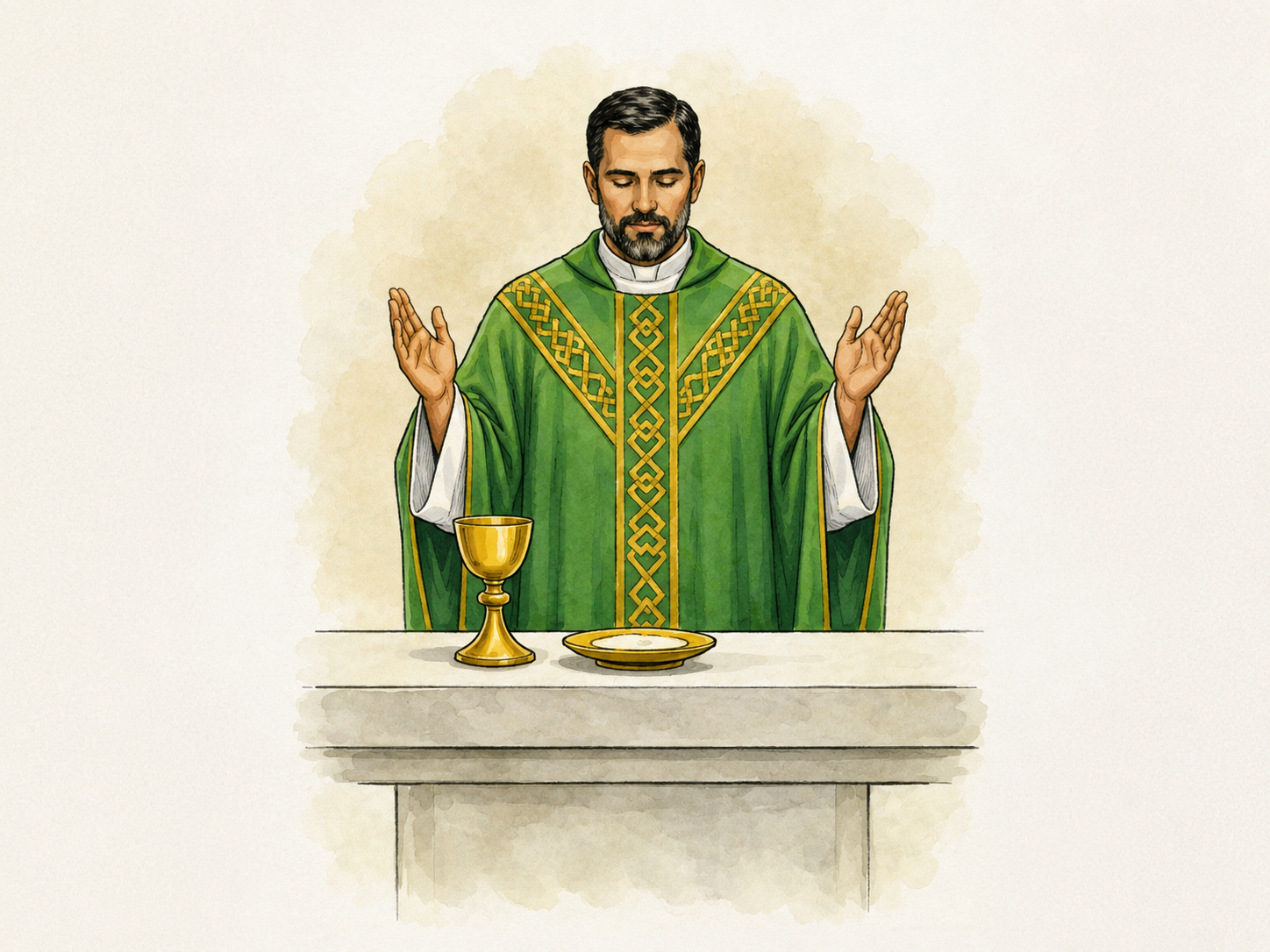
Figure 2 — The priest at the altar. Notice what the posture is doing: the hands are open and raised, the head is slightly inclined, the body is still. Nothing here is directed towards the congregation.
To many people the altar looks like a platform and the priest looks like the person running the show. That is an entirely reasonable first impression. It is a raised area at the focal point of the room, one person is standing there, everyone else is facing that way, and the person is dressed unlike anybody else present. Every visual convention we have learned from theatres, lecture halls, and concert stages says: this is a performance and that is the performer.
It is not, and the difference is worth setting out carefully.
A performer's task is to be watched. Their skill, presence, and interpretation are the point, and if you left without noticing them, they have failed. A presiding minister's task is very nearly the reverse. They are there to carry a rite that is not theirs, in words they did not write, on behalf of people whose worship it is. The old phrase for doing this well is ars celebrandi, the art of celebrating, and the art consists very largely in not getting in the way. If you leave a liturgy with a strong impression of the priest's personality, something has usually gone slightly wrong — not sinfully wrong, but wrong in the way that a window drawing attention to itself has gone wrong.
The priest stands at the altar because the altar, not the priest, is the focal point of the room. It is the table of the Sacrament, the place of offering and thanksgiving, and the ancient Christian imagination has always seen it as the point where the Church's prayer is gathered up. The minister stands there as a servant of that action.
You will see two positions for this, and both are ancient. In one, the priest stands at the people's side of the altar, facing across it towards the congregation, so that the action is visible. In the other, the priest stands on the same side as the people, facing the same way they face, so that the whole assembly including the priest is turned together towards God. Neither is a modern novelty and neither is a betrayal; the second is often called ad orientem, facing east, and the first versus populum, towards the people. Different traditions and different congregations within the same tradition make different choices. If you find yourself in a strong argument about this, you have wandered off the subject of the liturgy and into the subject of the furniture.
What matters is the thing both positions are trying to say, which is this. The altar is not a stage. The liturgy is not a performance. The priest is not the centre. Christ is.
Part 8 — Before we go further: grace rules
One principle governs everything else in this course, and it is best stated at the beginning rather than tucked in at the end as a kindly afterthought.
Grace rules
Nothing described in these four units is required in order for worship to be acceptable to God.
A congregation gathered in a borrowed room, around an ordinary table, led by someone in a plain shirt and a stole, praying honestly, worships fully and truly. It lacks nothing. Grace is not rationed according to the quality of the fabric, and God has never yet declined an offering on the grounds that the vessels were inexpensive.
Say it plainly: grace rules, and poverty must never be shamed. Where money is short, a clergy shirt and a stole will do perfectly well, and no one should ever be made to feel small for what they cannot afford. Any use of this course to make somebody feel poor would be a straightforward misuse of it.
Why explain the signs, then, if none of them is necessary? Because they were not built as a barrier to keep people out. They were built as a door, to teach, to steady the attention, and to draw the eye and the heart towards Christ. A door is only useful to somebody who knows it is there. That is what this course is for.
Further Reading and Resources
A note about these resources — The links and suggestions below are offered in the spirit of generous formation, not formal obligation. You will not be asked to reproduce specific content from any external source in your assessment. What you will find, however, is that those who engage with these materials tend to write with greater depth, reflect with greater honesty, and bring something richer to their cohort discussions. Think of them as an open door — the Institute has gone to the trouble of finding it for you, and a serious candidate will rarely stand in the doorway when there is so much worth walking into. All external links open on third-party websites. The Institute does not host, control, or endorse third-party content, and links may change over time. If a link no longer works, a simple search using the title and author will usually locate the resource without difficulty.
Primary sources
| Source | Where to find it | Copyright position |
|---|---|---|
| Justin Martyr, First Apology, chapters 65 to 67 (about AD 155). The earliest full description of a Christian Sunday assembly. Short, and startlingly familiar. | newadvent.org/fathers/0126.htm | The English translation is from the Ante-Nicene Fathers series of 1885 and is in the public domain worldwide. The web page presentation is the publisher's own. Link only; do not copy the page itself into course materials. Quoting the translated text is unrestricted. |
| The Book of Common Prayer, 1662 — the Order for the Administration of the Lord's Supper. The classic Western liturgy in English, and the source of a great deal of the phrasing you will meet. | justus.anglican.org/resources/bcp/1662/baskerville.htm | The text is in the public domain in South Africa, the United States, and most of the world. In the United Kingdom the 1662 Prayer Book remains Crown copyright, administered under letters patent by the Cambridge University Press. Reproduction for teaching outside the United Kingdom is unrestricted; note the position for United Kingdom learners. |
| The Sarum Missal in English, translated by A. Harford Pearson (2nd edition, 1884). The medieval English use in full, including its rubrics. | archive.org/details/cu31924092460033 | Public domain. Published well before 1929, no surviving copyright in text or translation. Free to reproduce, adapt, and use commercially. |
| The Old Catholic Missal and Ritual (1909), prepared by A. H. Mathew for English-speaking Old Catholic congregations. A vernacular Western rite from the early twentieth century. | archive.org/details/a592392300mathuoft | Public domain. Published 1909, no surviving copyright. Free to reproduce, adapt, and use commercially. |
Secondary sources
| Source | Where to find it | Copyright position and any caution |
|---|---|---|
| Louis Duchesne, Christian Worship: Its Origin and Evolution, translated by M. L. McClure. The standard older survey of how the Latin liturgy took the shape it has. | archive.org/details/christianworship00duch_1 | Public domain; free for all uses including commercial. Caution: written from a Roman Catholic standpoint of the early twentieth century, and its historical judgements have been revised by later scholarship. Read it for the outline, not as the last word. |
| Adrian Fortescue, The Mass: A Study of the Roman Liturgy (1912). Detailed, readable, and still quoted a century later. | archive.org/details/TheMassAStudyOf | Public domain; free for all uses including commercial. Caution: unapologetically Roman Catholic and pre-conciliar in tone, and occasionally dismissive of other Western traditions. Its treatment of Anglican and Old Catholic worship does not reflect this Institute's position. |
| Edmund Bishop, Liturgica Historica (1918). Essays on the liturgy and religious life of the Western Church, including the classic study of the genius of the Roman rite. | archive.org/details/liturgicahistori00bish | Public domain; free for all uses including commercial. Demanding but rewarding. |
| Gresham College public lectures on medieval music, worship, and the life of the Church. Free, filmed, and given by serious scholars. | gresham.ac.uk and youtube.com/GreshamCollege | Supplementary only. These lectures are made freely available to view but remain the copyright of Gresham College and the individual lecturers. Link only; do not download, re-host, or embed as course content, and do not assess on them. |
Before you move to the next unit
Tick each of these when it is true. If one of them is not true yet, the unit page is still there and nobody is timing you.
- I can explain what the word liturgy originally meant, and why “public work” is a better translation than “ritual”.
- I can describe, in rough order, what Justin Martyr says happened at a Christian Sunday gathering around the year 155.
- I can identify the two halves of a liturgy and say which one comes first.
- I can give at least two serious reasons why a church might use a fixed text, and at least one honest objection to doing so.
- I can explain what a rite is, and name at least two branches of the Western Rite family.
- I can explain why the altar is not a stage, without making the priest sound unimportant.
- I have understood that nothing in this course is required for worship to be acceptable to God.
- I have sat the Unit 1 quiz and passed it at eighty per cent or better.