
Unit 2 — What the Church Wears
- View
Part 1 — Why clothing at all
Many people see vestments and assume they are costumes: pageantry, dressing up, religious theatre. That is a perfectly understandable reaction. If nobody explains them, that is exactly how they look, and a certain amount of nonsense has been written over the centuries by people who evidently enjoyed the fabric rather more than the theology.
But vestments are not worn to entertain anybody, and they are not worn to make the clergy look important. They exist for close to the opposite reason. They are one of the ways the Church says that the liturgy is not about the minister's personality, taste, or standing. Worship is about God, and the clothing is arranged to keep saying so even when nobody is listening.
This unit does three things. It shows you where the garments actually came from, which is far less exotic than most people imagine. It walks you through them one at a time, so that you can name what you are looking at. And it explains liturgical colour, which is doing more teaching in a church than almost anything else you can see.
Part 2 — Where vestments came from
Here is the single most useful fact in this unit, and it surprises almost everybody.
Vestments were never designed. Nobody sat down and invented a special holy costume. What the clergy wear is, in origin, simply the ordinary formal dress of the late Roman world — the clothes that any respectable person might have worn to a serious occasion in the fourth or fifth century. The Church went on wearing them after everyone else had moved on to something new, and kept wearing them for so long that the everyday became the sacred.
Take the three principal garments in turn.
The chasuble, the large outer garment shaped rather like a poncho, descends from the paenula: a Roman travelling cloak, sleeveless, with a hole for the head, falling over the whole body. It was practical outdoor clothing for anybody caught in the weather. Cut it from good cloth and it became formal wear; go on using it for eight hundred years after the fashion changed and it became a chasuble.
The alb, the long white garment worn underneath, descends from the tunica alba, the white tunic that was the standard undergarment of the classical world. It is, quite literally, the shirt.
The stole, the long narrow band worn around the neck, most probably descends from a scarf or band of office worn by Roman officials as a mark of rank and duty. Its history is less certain than the other two, and honest scholars disagree; what is not in doubt is that by the sixth and seventh centuries it had become the ordained minister's mark.
So the pattern is consistent. What looks exotic to you now was once entirely unremarkable. The strangeness is not in the garments; it is in the fifteen hundred years that have passed since anybody wore them to dinner. When a visitor says a chasuble looks odd, the accurate reply is that it looked perfectly normal in about the year 400 and simply never went out of use.
This matters for more than curiosity's sake. It means the Church did not invent a sacred costume in order to set the clergy apart. It kept ordinary good clothing, and let time do the setting apart. That is a far humbler origin than most critics assume, and rather more interesting.
Part 3 — The garments, one at a time
Here is what you are actually looking at. Take it slowly; the names come with use, and nobody expects you to memorise them today.
| Garment | What it is | Who wears it, and what it says |
|---|---|---|
| Cassock | A long, close-fitting robe reaching the ankles, usually black, worn as everyday clerical dress rather than as a vestment proper. | Clergy, servers, and choir. It is the foundation garment rather than a liturgical vestment, and it says almost nothing by itself except “this person is on duty”. |
| Amice | A rectangle of white linen tied around the shoulders and neck, put on first. | Worn by ministers at the Eucharist in traditions that retain it. Originally practical — it protected costly outer garments from the neck — and long understood as a symbol of the helmet of salvation. |
| Alb | A full-length white garment reaching the ankles, from the Latin for “white”. | Worn by any minister at the altar, ordained or lay. It is the baptismal garment writ large, and it deliberately makes everyone at the altar look much the same. |
| Cincture | A cord or belt tying the alb at the waist. | Practical in origin, and long associated with self-restraint and readiness for work. |
| Stole | A long narrow band worn around the neck, matching the colour of the season. | The distinctive mark of ordination. A deacon wears it across the body from the left shoulder; a priest or bishop wears it hanging straight down. If you want to know a minister's order at a glance, look at the stole. |
| Maniple | A short band worn over the left forearm. | Once universal in the West, now largely disused outside traditions that keep the older ceremonial. It probably began as a napkin or handkerchief. |
| Chasuble | The large outer garment worn over everything else, in the colour of the day. | Worn by the priest or bishop presiding at the Eucharist, and by them alone. It is the vestment of the one who presides at the altar. |
| Dalmatic | A wide-sleeved outer garment, shorter and squarer than a chasuble. | Worn by the deacon at a solemn celebration. Its shape marks the deacon out as a distinct order, not a junior priest. |
| Tunicle | Similar to the dalmatic but plainer. | Worn by the subdeacon where that office is retained. |
| Surplice | A wide white garment with full sleeves, worn over a cassock, usually to the knee or below. | Worn for the daily offices, preaching, and occasional services, by clergy, readers, servers, and choirs alike. |
| Cope | A large semicircular cloak fastened across the chest, often richly decorated. | Worn for processions, blessings, and solemn offices — but not for celebrating the Eucharist. It is the ceremonial cloak rather than the eucharistic vestment. |
| Mitre | The tall folded headdress with two points. | Worn by a bishop. It is a mark of office, and by long custom it comes off during prayer. |
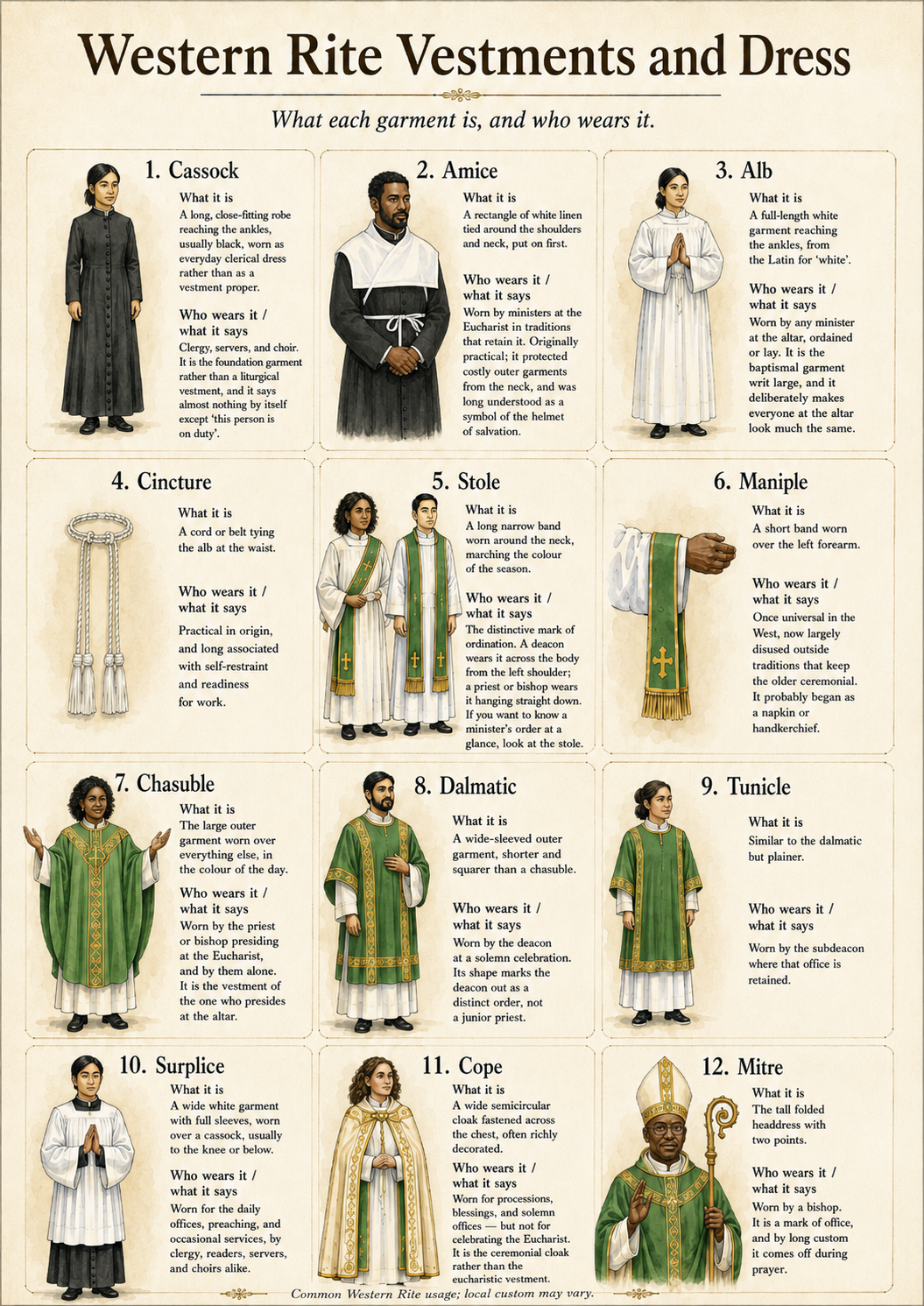
Figure 3 — Western Rite vestments and clerical dress: the principal garments named, illustrated, and placed in their usual ministerial context.
Two things to notice as you read that list. First, several of these garments are worn by lay people as readily as by clergy — the alb, the surplice, the cassock. The vested figures at an altar are not all ordained, and the clothing is not primarily a rank system. Second, the garments that are restricted are restricted by order, not by seniority: a deacon's stole is worn differently from a priest's because a deacon is a different order, not a lesser rank of the same one.
Part 4 — What vestments actually do
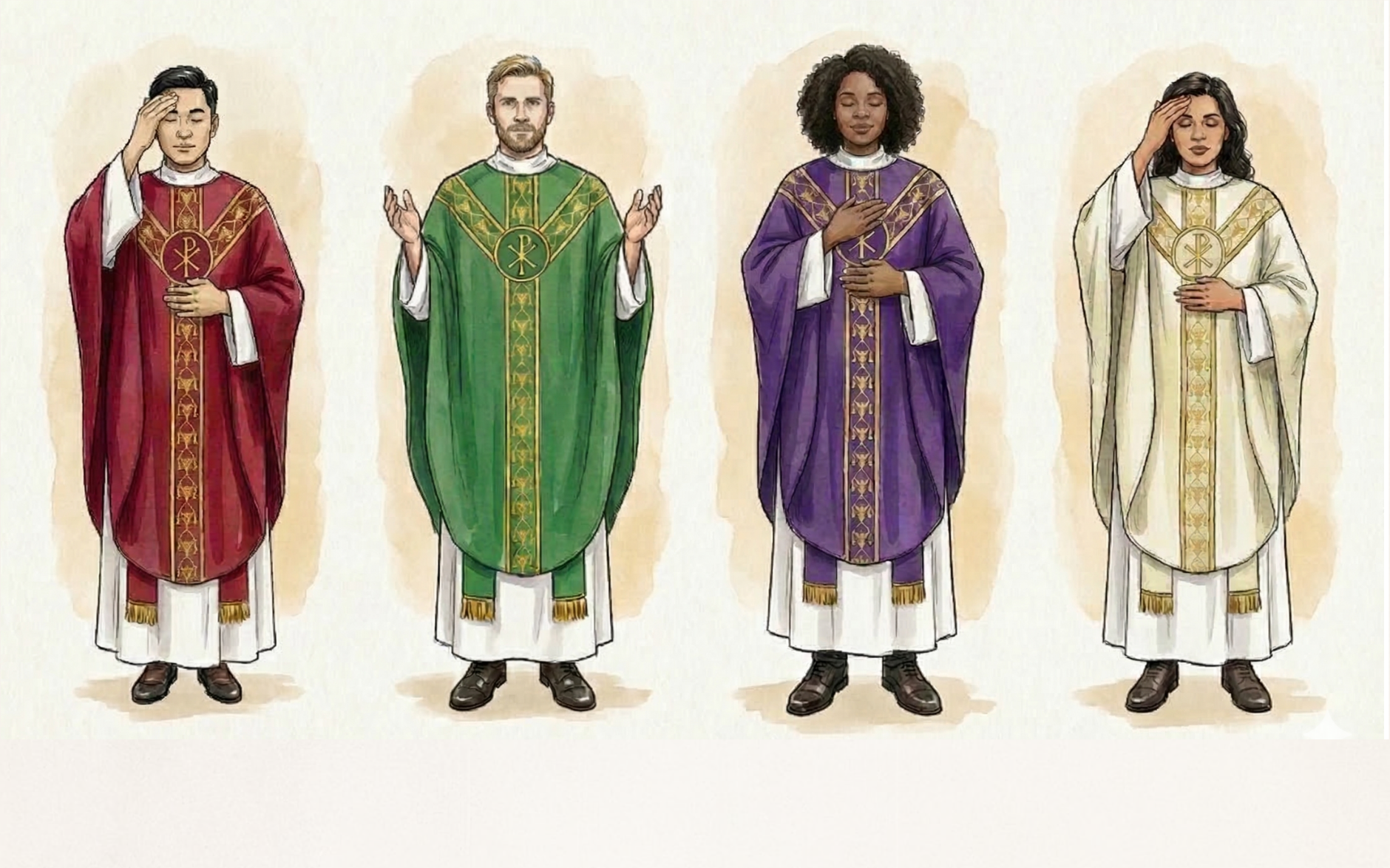
Figure 4 — Four ministers vested for the Eucharist in red, green, purple, and white. The people differ; the vesture does not. That is precisely the point.
Look carefully at that illustration, because it is doing several jobs at once.
Four different people are shown. They differ in age, in colouring, in build, in bearing. What they are wearing is, in every essential respect, identical — alb, stole, chasuble, in the colour of the day. If you were sitting in the fourth pew you would register the vestment long before you registered the person, and that is the intended effect.
That is the first thing vestments do. They conceal the individual. Not to erase the person, and not to pretend that who presides makes no difference, but to prevent the congregation's attention from settling on the wrong thing. Ordinary clothing carries an enormous amount of information — money, taste, class, age, fashion, effort. Vestments withdraw all of it at once. What is left is a role.
The second thing they do is signal role rather than rank. The stole tells you which order the minister belongs to. The chasuble tells you who is presiding at this altar today. None of it tells you who is senior, well thought of, or important, because that is not information the liturgy requires.
The third thing is connection across time and space. What that priest is wearing would be recognised by a Christian from Milan in the sixth century, from Salisbury in the fourteenth, and from a mission chapel on the other side of the world this morning. A small congregation in a borrowed hall is dressed like the whole Church, and that is a quiet but genuine consolation when the numbers are thin.
And the fourth is that they teach before anybody speaks. A visitor who has never opened a service book learns, in the first three seconds, that this is a set-apart action, that there is an order to it, and that the person at the front did not choose their own outfit. Considerable amounts of catechesis have been achieved by less.
Part 5 — Scripture and the clothing of worship
Vesture is not a late medieval indulgence dropped on top of a simpler faith. Set-apart clothing for those who serve at an altar appears at the very beginning of Israel's worship, and it is given with striking directness.
And you shall make a holy vestment for Aaron, your brother, with glory and elegance.
Exodus 28:2, Catholic Public Domain Version
Note the two words. Not merely serviceable, and not merely decent: glory and elegance. A few verses later the same is said of the tunics of Aaron's sons. Whatever one concludes about how far the priesthood of Israel maps onto Christian ministry — and the traditions differ — it is not possible to argue that Scripture is indifferent to how those who serve at an altar are dressed.
The heavenly worship of the Book of Revelation is likewise a vested worship.
After these things, I saw a great crowd, which no one could number, from all the nations and tribes and peoples and languages, standing before the throne and in sight of the Lamb, clothed in white robes, with palm branches in their hands.
Revelation 7:9, Catholic Public Domain Version
And here is the verse that keeps the whole subject in proportion, and that you should reach for whenever someone suggests that vestments make the clergy a superior class.
For as many of you as have been baptized in Christ have become clothed with Christ. There is neither Jew nor Greek; there is neither servant nor free; there is neither male nor female. For you are all one in Christ Jesus.
Galatians 3:27–28, Catholic Public Domain Version
Everyone in the room is vested. Most of them invisibly. The alb at the altar is the visible form of a garment every baptised person is already wearing, and the white robe of the baptised is the reason the alb is white in the first place. Vesture does not create a caste; it makes one baptismal reality briefly visible so that the whole congregation can see what is true of all of them.
Part 6 — Why the colours change
People often assume the changing colours in a church are decoration, or that somebody simply likes green. They are not, and the colour is very probably teaching you more than any other single thing in the building.
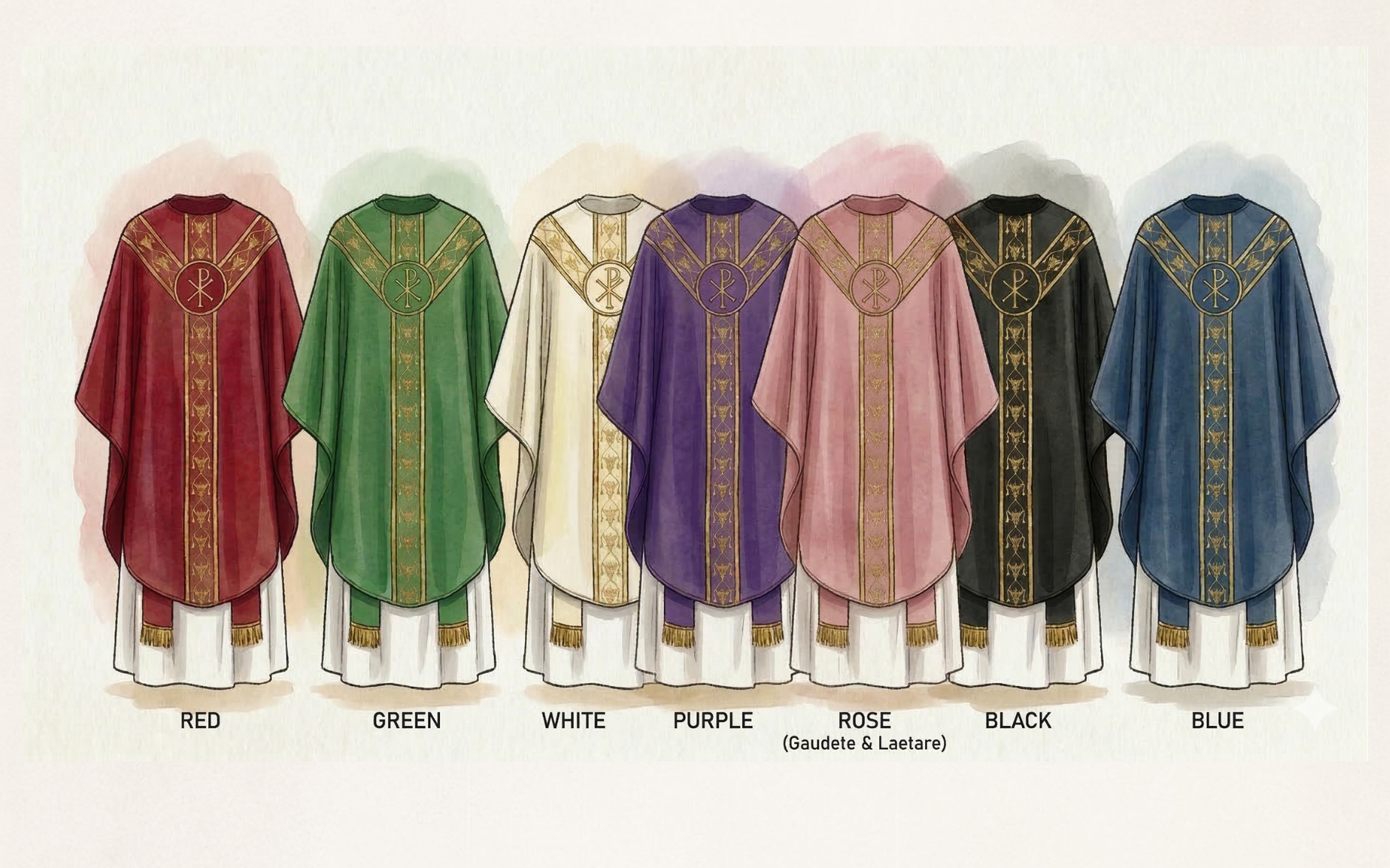
Figure 5 — The liturgical colours: red, green, white, purple, rose, black, and blue. Colour sequences differ between traditions; the meanings below are the common Western ones.
Liturgical colour teaches the rhythm of the Christian year without a word being spoken. Before the first hymn, before the readings, before anybody has explained anything, the room has already told you what season the Church is in and what mood the day carries. A congregation that has grown up with it can read the year the way you read a clock.
| Colour | What it teaches | When you will usually see it |
|---|---|---|
| Green | Growth, and the steady ordinary life of faith. The colour of things quietly getting on with it. | The long stretches of the year outside the great seasons — most Sundays, in fact. Green is the colour of the Church's ordinary working life, which is where most of Christian living happens. |
| Red | Fire, blood, the Holy Spirit, martyrdom, and bold witness. | Pentecost; the feasts of martyrs; Palm Sunday and Good Friday in many traditions; ordinations and confirmations in some. |
| White | Joy, light, resurrection, purity, and feast. Gold is often used in its place on the greatest days. | Christmas and Easter and their seasons; feasts of the Lord and of Our Lady; saints who were not martyred; weddings; and in many places funerals, as a deliberate statement of resurrection hope. |
| Purple | Preparation, repentance, and solemn reflection. Not gloom, but seriousness. | Advent and Lent. Used in some traditions for funerals and requiems. |
| Rose | A softer joy breaking into a penitential season — a glimpse of the feast ahead. | Two days only in most traditions: the Third Sunday of Advent (Gaudete Sunday) and the Fourth Sunday of Lent (Laetare Sunday). |
| Black | Mourning, grief, and the plain seriousness of death. | Requiems and funerals where the older custom is kept, and All Souls' Day. Its use has narrowed considerably in modern practice. |
| Blue | Associated with the Sarum tradition and with Advent in a number of Western uses. | Advent, in traditions that follow the Sarum sequence. You will meet it in some places and not in others, and its presence usually tells you something about that congregation's liturgical ancestry. |
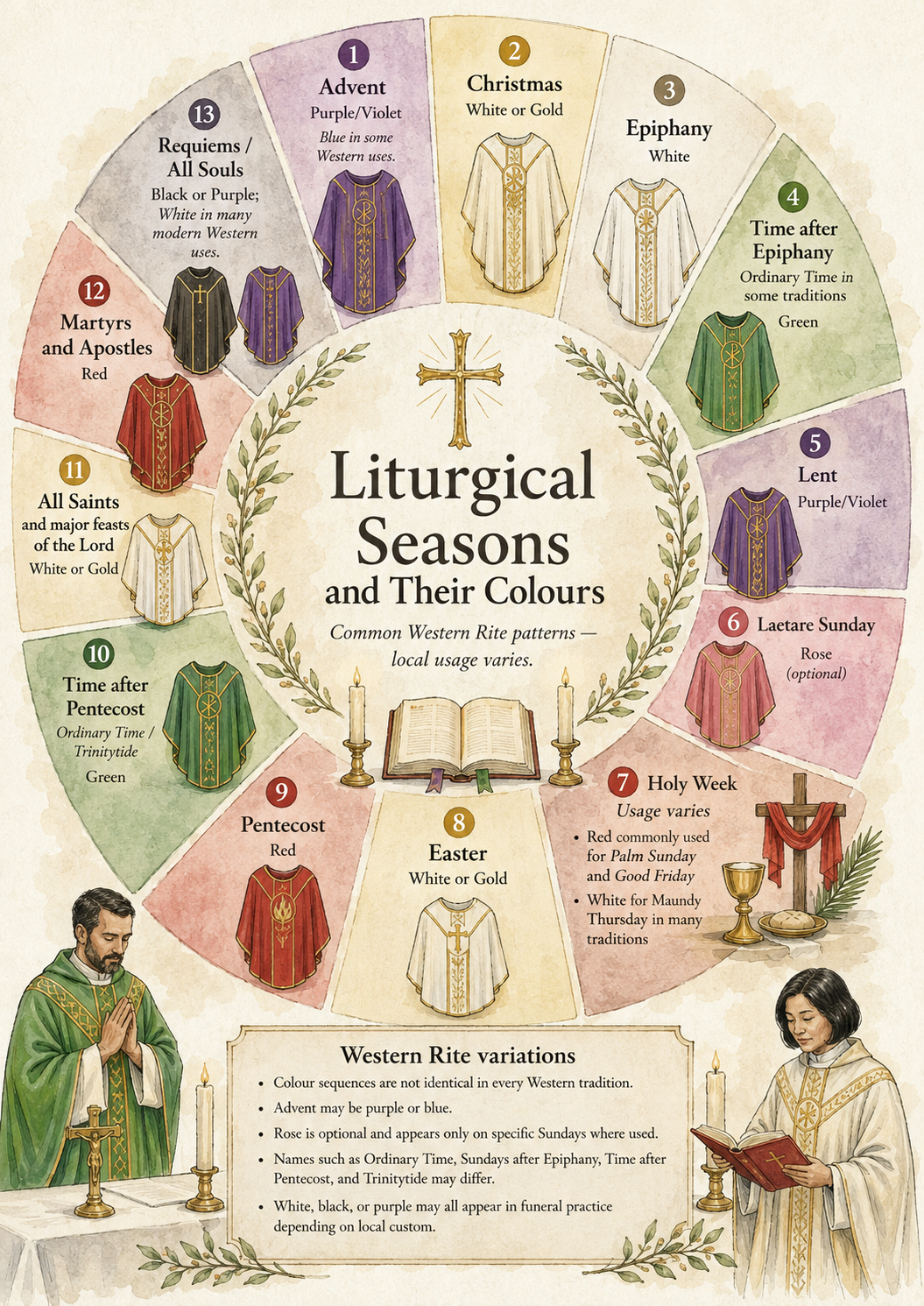
Figure 6 — The liturgical seasons and their colours, as they are commonly kept in the West. The panel at the foot of the wheel is the important part: these are patterns, not rules, and local usage varies.
Now the caution, and it is an important one. There is no single universal colour sequence. The scheme above is the common Western one, but the medieval English uses did not agree with the later Roman sequence, and traditions today still differ over Advent, over funerals, and over a good many saints' days. If you walk into a church in Advent and find blue where you expected purple, you have not found an error. You have found a different and perfectly respectable inheritance. Never assume your own tradition's table is the rule everywhere; that assumption has caused more unnecessary friction than almost any other in this field.
Part 7 — The two rose Sundays
Rose deserves a paragraph of its own, because it is the one colour that most reliably prompts a question from visitors, and because the answer is charming.
The two rose Sundays
Rose appears twice a year. The Third Sunday of Advent is called Gaudete Sunday, and the Fourth Sunday of Lent is called Laetare Sunday. Both names are simply the first word of the entrance chant appointed for the day in Latin, and both words mean the same thing: rejoice.
The logic is pastoral rather than decorative. Advent and Lent are both seasons of preparation, and both are long enough for their seriousness to become heavy. So roughly two-thirds of the way through each one, the Church lightens the purple towards rose for a single day and tells the congregation to take heart, because what they are preparing for is nearly here. It is a season taking a breath.
Once you know that, you will never see a rose vestment without smiling slightly, which is precisely the intended effect.
Part 8 — Cost, conscience, and not shaming anybody
Now the part that some courses leave out, and that this one puts in the middle of the unit rather than at the end.
Vestments can be expensive. Good ones are hand-made from good cloth by people who deserve to be paid properly, and a full set in every liturgical colour is beyond the reach of a great many congregations and a great many individual ministers. It would be dishonest to spend a unit explaining the meaning of the chasuble without saying plainly what follows from that.
Grace rules — what this means for vesture
Grace rules. Poverty must never be shamed. Where funds are short, a clergy shirt and a stole are entirely sufficient, and the liturgy celebrated in them is entirely complete. A single set in one colour, used all year, is not a compromise anyone need apologise for. A borrowed vestment, a home-made one, a well-mended old one — none of these diminishes anything.
If you are ever in a position to advise a new or struggling congregation, the order of purchase that most experienced ministers would recommend is: a stole first, because it is the mark of order; then a white set, because the greatest feasts deserve it; then green, because you will use it most; and everything else as and when God provides. Anyone who tells a poor congregation that its worship is deficient because its vesture is modest has misunderstood both the vesture and the worship.
Part 9 — What vestments are not
To finish, three things worth saying plainly.
Vestments are not a claim to personal holiness. The person wearing them may be having a wretched week, and the garment makes no assertion whatever about their spiritual state. It speaks about the office, not the occupant.
Vestments are not a barrier between the congregation and God. If anything, they exist to remove one — the barrier of personality that would otherwise stand between the congregation and the action.
And vestments are not necessary. What may look unnecessary at first often carries history, theology, reverence, and meaning; but carrying meaning and being necessary are two different things, and this course will not confuse them.
Further Reading and Resources
A note about these resources — The links and suggestions below are offered in the spirit of generous formation, not formal obligation. You will not be asked to reproduce specific content from any external source in your assessment. What you will find, however, is that those who engage with these materials tend to write with greater depth, reflect with greater honesty, and bring something richer to their cohort discussions. Think of them as an open door — the Institute has gone to the trouble of finding it for you, and a serious candidate will rarely stand in the doorway when there is so much worth walking into. All external links open on third-party websites. The Institute does not host, control, or endorse third-party content, and links may change over time. If a link no longer works, a simple search using the title and author will usually locate the resource without difficulty.
Primary sources
| Source | Where to find it | Copyright position |
|---|---|---|
| Exodus 28 in full — the vesting of Aaron and his sons, and the origin of set-apart clothing for those who serve at an altar. | sacredbible.org/catholic/ | The Catholic Public Domain Version is placed entirely in the public domain by its translator. Free to quote, print, adapt, and use commercially without permission or attribution. |
| The Sarum Missal in English, translated by A. Harford Pearson (1884) — the vesting prayers and the rubrics directing which colour is used when. | archive.org/details/cu31924092460033 | Public domain. Free to reproduce, adapt, and use commercially. Note that its colour sequence differs from the later Roman one; that difference is itself part of the lesson. |
| The Old Catholic Missal and Ritual (1909) — vesting prayers and colour rubrics in a vernacular Western rite of the early twentieth century. | archive.org/details/a592392300mathuoft | Public domain. Free to reproduce, adapt, and use commercially. |
| Percy Dearmer, The Parson's Handbook (1907 edition) — practical directions on vesture and ceremonial in the English tradition, written to recover the Sarum inheritance. | archive.org/details/parsonshandbookc00dearuoft | Public domain in this edition. Free to reproduce and adapt. Caution: Dearmer argues a strong case for one particular English usage and is dismissive of Roman practice; read him as an advocate, not a neutral referee. |
Secondary sources
| Source | Where to find it | Copyright position and any caution |
|---|---|---|
| Joseph Braun, “Vestments”, in the Catholic Encyclopedia (1912). Still the most thorough single article in English on the origin of each garment. | newadvent.org/cathen/15388a.htm | The 1912 text is in the public domain. The web page presentation is the publisher's own. Link only; quote the text freely but do not copy the page. Caution: written from an early twentieth-century Roman Catholic standpoint. |
| Patrick Morrisroe, “Liturgical Colours”, in the Catholic Encyclopedia (1908). Sets out how the colour sequence developed and why it was never wholly uniform. | newadvent.org/cathen/04134a.htm | The 1908 text is in the public domain; page presentation is the publisher's own. Link only. Caution: describes the Roman sequence as normative and treats other Western sequences as departures. |
| The Victoria and Albert Museum, Introducing Opus Anglicanum — the medieval English embroidery that produced some of the finest vestments ever made, with photographs of surviving copes and chasubles. | vam.ac.uk/articles/about-opus-anglicanum | Supplementary only. Museum text and photographs are the copyright of the Victoria and Albert Museum. Link only; do not copy text or images into course materials. Excellent for seeing what the garments in this unit actually look like at close range. |
| Opus anglicanum, Encyclopaedia Britannica. A short, reliable orientation to the same subject. | britannica.com/art/opus-anglicanum | Supplementary only. Copyright Encyclopaedia Britannica. Link only; do not reproduce. |
Before you move to the next unit
Tick each of these when it is true. If one of them is not true yet, the unit page is still there and nobody is timing you.
- I can explain where the chasuble and the alb came from, and why they looked ordinary when they were new.
- I can name the alb, the stole, and the chasuble, and say who wears each.
- I can explain how a deacon's stole is worn differently from a priest's, and why that difference is about order rather than seniority.
- I can give at least three things vestments do, without saying that they make the clergy look important.
- I can explain what each of the main liturgical colours teaches.
- I can explain why two different churches may use different colours on the same Sunday, and why neither is wrong.
- I know what Gaudete and Laetare mean, and why those two Sundays are rose.
- I can state the principle that grace rules and poverty must never be shamed, and explain what it means in practice for vesture.
- I have sat the Unit 2 quiz and passed it at eighty per cent or better.