
Unit 4 — The Body at Prayer, and the Place of Beauty
- View
Part 1 — We do not worship as disembodied minds
You have nearly finished, and this last unit gathers up something that has been running quietly underneath the whole course.
Every unit so far has been about a physical thing. Cloth. Colour. A hand tracing a shape. Bread in two pieces. None of it was accidental. Christian worship has never been only inward, only invisible, or only a matter of what one thinks while sitting still. We stand, bow, kneel, make the sign of the cross, process, and raise our hands, because we do not worship as disembodied minds. We worship as whole persons, and the body is a participant rather than a piece of luggage the soul has to carry to church.
Paul puts it about as plainly as it can be put.
And so, I beg you, brothers, by the mercy of God, that you offer your bodies as a living sacrifice, holy and pleasing to God, with the subservience of your mind.
Romans 12:1, Catholic Public Domain Version
The body is what is offered. The mind comes along in support. That is very nearly the reverse of how most modern people instinctively rank the two, and it is worth sitting with for a moment before going on.
Part 2 — The raising of the hands
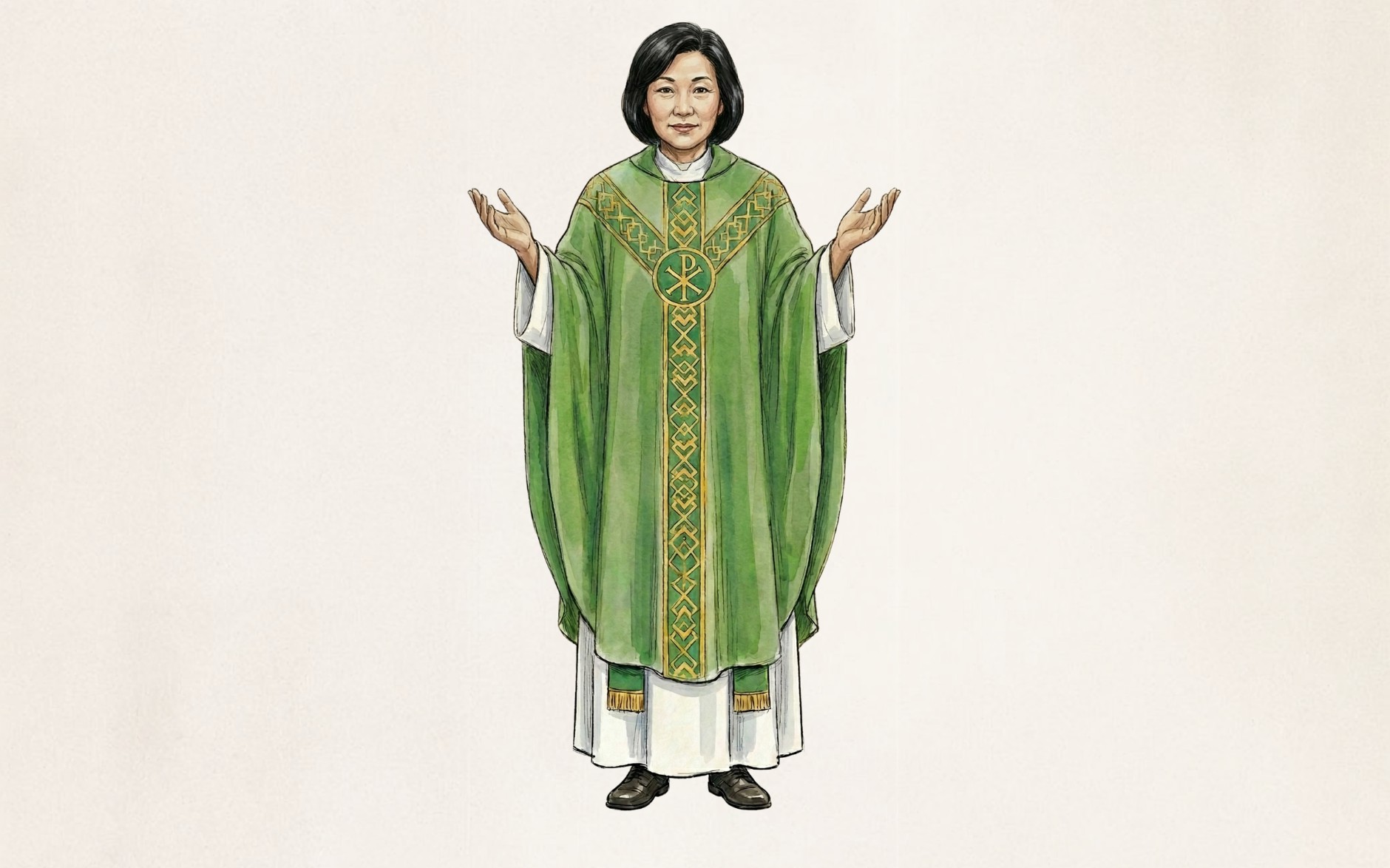
Figure 10 — The orans posture: hands raised and open, arms extended, palms turned upward. Older than any vestment in this course.
To many visitors this looks unusual, dramatic, or faintly excessive — and often it is quietly assumed to be a modern import from more demonstrative forms of Christianity.
It is the opposite. The raising of the hands in prayer, known as the orans posture, is one of the oldest attitudes of prayer we can document, and the presiding minister who stands with hands raised is doing the ancient thing, not the innovative one.
It runs all through the Scriptures of Israel. Moses extends his hands to the Lord and the thunder ceases. Moses holds up his hands over the battle until Aaron and Hur have to support them. Solomon stands before the altar and spreads out his hands towards heaven at the dedication of the Temple, and later kneels with his hands still extended. Ezra blesses God, and the whole assembly answers Amen, Amen, lifting up their hands. And the Psalter returns to it again and again.
Let my prayer be guided like incense in your sight: the lifting up of my hands, like the evening sacrifice.
Psalm 140:2, Catholic Public Domain Version
In the nights, lift up your hands in sanctity, and bless the Lord.
Psalm 133:2, Catholic Public Domain Version
The first Christians simply carried on. Paul assumes the posture as the normal one without needing to argue for it.
Therefore, I want men to pray in every place, lifting up pure hands, without anger or dissension.
1 Timothy 2:8, Catholic Public Domain Version
And when Christians began painting on the walls of the catacombs, the figure at prayer they painted most often was a figure standing with arms raised and open. That is what a praying Christian looked like, in the mind of the people who were actually doing it.
So what is the gesture saying? Three things, mostly at once. It is open — nothing is being held, nothing concealed, nothing defended. It is upward — a body admitting where it thinks help comes from. And it is offering — the whole self extended, not merely the words. It is very hard to raise your hands and remain guarded, which may be the point.
One honest note. In most Western Rite congregations the orans posture is used by the presiding minister rather than by the whole assembly, and that is a matter of custom rather than doctrine. Where a congregation raises its hands together it is doing something ancient; where it does not, it is following a later convention. Neither should be treated as the mark of a serious church.
Part 3 — The other postures, and what each one says
The raised hands are the most striking posture, but they are not the only one. A liturgical congregation is doing something with its body almost continuously, and each movement carries a meaning.
| Posture | Where you will meet it | What it says |
|---|---|---|
| Standing | The Gospel, the creed, the great prayer of thanksgiving in many traditions, and by very ancient custom on Sundays and throughout the Easter season. | Attention, readiness, and resurrection. Standing is the posture of the free and the risen; the early Church regarded kneeling on a Sunday as almost inappropriate for that reason. |
| Kneeling | Confession, penitential prayer, and in many traditions the eucharistic prayer and the reception of communion. | Penitence, petition, humility, and dependence. It is the posture of somebody asking rather than declaring. |
| Sitting | The readings other than the Gospel, the sermon, and the psalms in some traditions. | Receptive listening. Sitting is not a rest between the real parts; it is the posture of a learner. |
| Bowing | At the name of Jesus, at the altar on entering and leaving, and at particular phrases in the creed. | Reverence and acknowledgement. A bow is a small, cheap, almost invisible act of homage, which is exactly why it survives. |
| Genuflection | Before the sacrament reserved, and at certain moments in the rite where the custom is kept. | A sharper form of the same reverence: the knee touching the ground before what is holy. |
| The sign of peace | Before communion in most modern Western rites; in some older uses, in another position. | Reconciliation made physical. You cannot approach the one table while refusing to touch the hand of the person beside you. |
| Striking the breast | At the confession, and at penitential phrases in some rites. | An old and unembarrassed admission of fault, made with the body when words feel too easy. |
Two of these deserve an extra word. Bowing is the most neglected gesture in modern Western worship and the easiest to recover; Paul's great hymn says that at the name of Jesus every knee would bend, and a slight inclination of the head at that name costs nothing and teaches a great deal. And standing is the posture most people assume is casual, when it is in fact the ancient posture of Christian prayer.
Part 4 — Why posture varies, and why that is not a scandal
If you visit three churches in the same tradition you may well find three different practices. In one the congregation kneels for the eucharistic prayer; in the next it stands throughout; in the third it stands and then kneels partway. Somebody will usually tell you, with total confidence, that theirs is the correct one.
They are describing a custom, not a law. Posture in Western worship has varied by region, by century, and by building — sometimes for reasons as unspiritual as whether a church had pews, or a floor anyone would willingly kneel on. Kneeling for the whole eucharistic prayer is a relatively late Western habit; standing is older and is the norm in much of the wider Church.
The pastoral rule for a visitor
The pastoral rule is simple and worth carrying with you. Do what the congregation you are visiting does, unless your body will not let you, in which case do what your body allows and think no more about it. Nobody's worship has ever been invalidated by a bad knee. A congregation that makes a visitor feel watched for sitting at the wrong moment has failed at something considerably more important than posture.
Part 5 — What the Church means by beauty
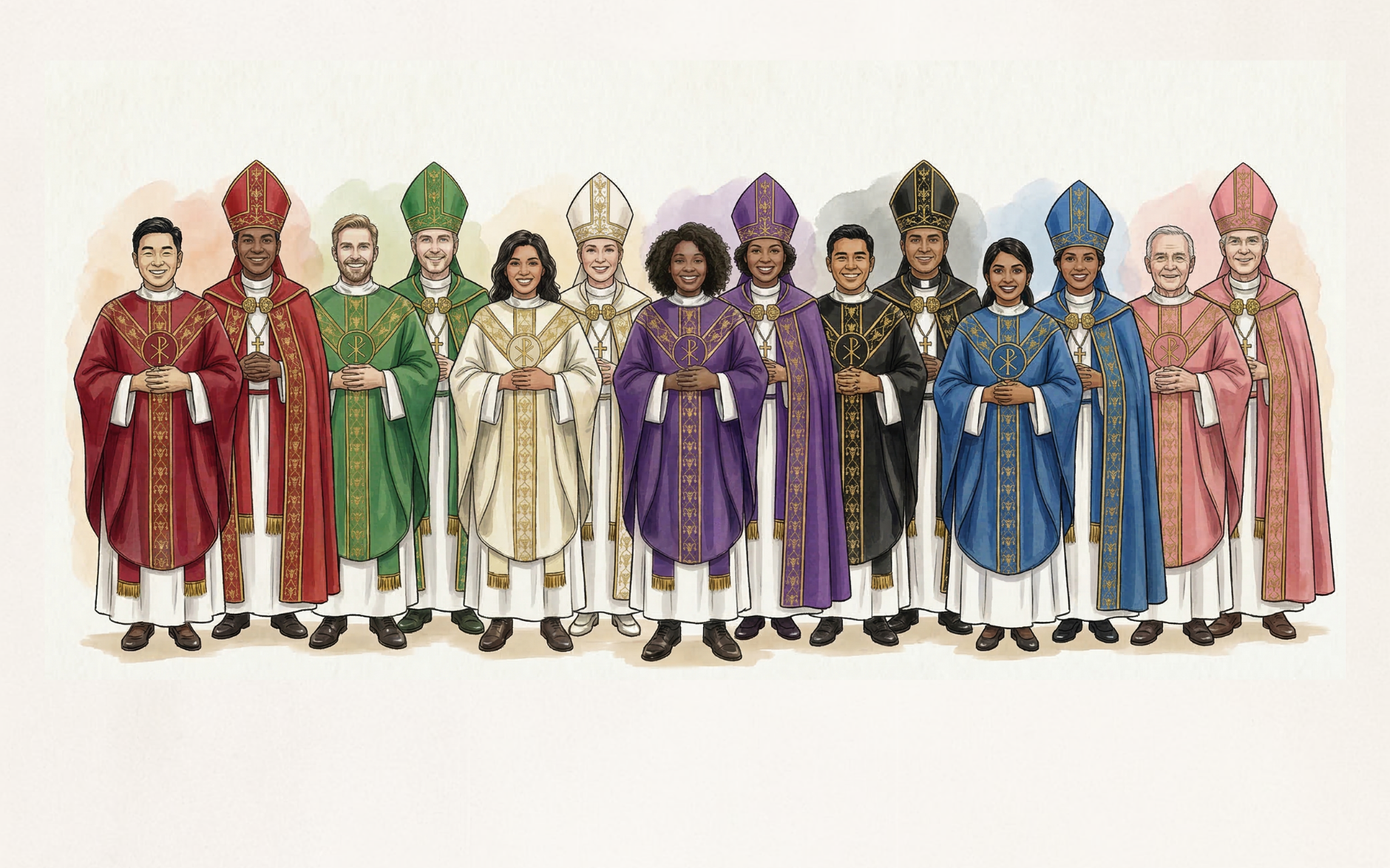
Figure 11 — Beauty in worship: colour, vesture, vessels, light, and order, offered together.
Some people hear the word beauty in connection with worship and assume it means expense, showiness, or an attempt to impress. That is a fair suspicion. Churches have certainly used beauty badly, and there are buildings in Europe that are essentially arguments about money conducted in stone.
But that is not what the Church means by the word, and the difference is worth being precise about.
Beauty in worship is not vanity. It is reverence made visible. It is the outward form of the conviction that what is being done here matters — that this is not casual, not rushed, and not thoughtless. Colour, vesture, vessels, gesture, music, and order all say the same thing in different materials: attention is being paid here.
There is an older thought underneath this, and Scripture states it directly.
For, by the greatness of the creation and its beauty, the creator of these will be able to be seen discernibly.
Wisdom 13:5, Catholic Public Domain Version
Beauty leads somewhere. It is not a terminus. Creation's beauty points past itself to the One who made it, and the Church has consistently held that the beauty of worship works the same way — it is a signpost, and a signpost that keeps your eye on itself has failed at its only job.
Confession and beauty are in his sight. Sanctity and magnificence are in his sanctuary.
Psalm 95:6, Catholic Public Domain Version
So beauty is not an extra in worship, and it is not a luxury the Church indulges when funds permit. It is one of the ways the Church bears witness that God is holy, and that worship is meant to draw us beyond ourselves.
Part 6 — Beauty and money are not the same thing
Now the essential qualification, and it is the same principle you met in Unit 1 and Unit 2, applied here for the last time.
Beauty in worship has almost nothing to do with what things cost.
A simple liturgy can be profoundly beautiful when it is offered with care, dignity, and love. A clean cloth on a plain table. A single candle lit deliberately rather than absently. Bread that somebody baked. Words said as though they were true. Silence that is allowed to last. None of that requires money, and all of it is beautiful in exactly the sense this unit means.
And the reverse holds. A church may possess a great deal of expensive equipment and offer worship that is careless, hurried, and self-satisfied. Costly things arranged without attention are not beautiful. They are only costly.
Grace rules
Grace rules. Poverty must never be shamed. Beauty is not about luxury; it is about giving God our best, however modest that best may be. The widow's two coins have never been the smaller offering in this tradition, and any use of the word beauty that makes a poor congregation feel inadequate has inverted the entire teaching.
If you take one practical thing from this unit, let it be this: the question is never “can we afford something better?” but “are we offering this with care?” The second question is available to everyone, and it is the one that is actually being asked.
Part 7 — What beauty is for
Why does any of it matter, though? A course that has spent ten hours explaining signs ought to be able to say what the signs accomplish.
Here is the answer, and it is smaller and more practical than you might expect. Beauty forms attention, and attention forms love.
Human beings become what they pay attention to. A congregation that spends an hour a week attending carefully to the death and resurrection of Christ, in a room arranged to make that attention easier, is being slowly shaped by it. Colour tells them what season of the mystery they are in. Vesture keeps their eyes off the wrong subject. Gesture marks what is important so they do not drift past it. Order means they are not spending their attention on working out what happens next.
None of that is magic, and none of it works automatically. It is simply the recognition that attention is difficult, that human beings are easily distracted, and that a wise Church arranges the room to help rather than hinder. Beauty in worship is, at bottom, an act of pastoral kindness towards people whose minds wander.
It lifts the heart. It shapes attention. It helps proclaim that sacred things are taking place. That is the whole of its ambition.
Part 8 — A door, not a barrier
We end where the first unit began.
Nothing described in these four units is required to make worship acceptable to God. A congregation gathered in a simple room, with a faithful heart and an honest prayer, worships truly and lacks nothing. That was true on the first page and it is true on the last, and everything in between should be read in its light.
These signs exist not to raise a barrier, but to open a door — to teach, to steady, and to draw the eye and the heart towards Christ. A door is a kindness. It is also, unlike a barrier, something you may walk through in either direction, at your own pace, whenever you are ready.
If these units have raised questions, that is exactly what they were for. You are warmly invited to ask them of whoever leads worship where you are, and you should not be shy about it. In this Institute's experience, most clergy are delighted to be asked, and a good many of them have been waiting years for somebody to take an interest.
Part 9 — Where you might go next
You have finished a short course, and it has done what a short course can do. If you would like to go further, here are three honest directions.
Go deeper into the texts. Every liturgical source cited in this course is freely available and costs nothing. Read the Order for Holy Communion in the 1662 Book of Common Prayer straight through, then read the same rite in the Sarum Missal, and notice what each one keeps and what each one moves. You will learn more from that comparison than from a shelf of commentary.
Go deeper into the practice. Visit a congregation in a Western Rite tradition other than your own. Go twice, because the first visit is spent being a stranger and the second is when you start noticing things. Take this course's four units with you as a way of paying attention.
Go deeper into study. If this has stirred something more than curiosity — if you find you want to understand the sacraments, the ministry, or the shape of Christian formation properly — the Institute of Ministry offers longer and more demanding courses, and this one was designed as a doorway into them.
Whichever you choose, you now have what you did not have ten hours ago: you can walk into a liturgical church, understand what you are seeing, and explain it kindly to somebody else. That was the whole aim, and it was never a small one.
Further Reading and Resources
A note about these resources — The links and suggestions below are offered in the spirit of generous formation, not formal obligation. You will not be asked to reproduce specific content from any external source in your assessment. What you will find, however, is that those who engage with these materials tend to write with greater depth, reflect with greater honesty, and bring something richer to their cohort discussions. Think of them as an open door — the Institute has gone to the trouble of finding it for you, and a serious candidate will rarely stand in the doorway when there is so much worth walking into. All external links open on third-party websites. The Institute does not host, control, or endorse third-party content, and links may change over time. If a link no longer works, a simple search using the title and author will usually locate the resource without difficulty.
Primary sources
| Source | Where to find it | Copyright position |
|---|---|---|
| Tertullian, On Prayer, chapters on kneeling, standing, and the posture of the hands (about AD 200–206). The earliest sustained Christian discussion of what the body does while praying. | newadvent.org/fathers/0322.htm | The 1885 English translation is in the public domain worldwide; the page presentation is the publisher's own. Link only; quote the translated text freely. Caution: rigorist in tone, and Tertullian ended outside the Church's communion. |
| Psalms 62, 133, and 140, and 1 Timothy 2 — the raising of the hands in Israel's prayer and in the earliest Christian assemblies. | sacredbible.org/catholic/ | The Catholic Public Domain Version is entirely in the public domain. Free to quote, print, adapt, and use commercially. Remember that this version follows the older Latin psalm numbering. |
| The Book of Common Prayer, 1662 — read the rubrics rather than the prayers, and note how often they direct the body rather than the voice. | justus.anglican.org/resources/bcp/1662/baskerville.htm | Public domain in South Africa, the United States, and most of the world. In the United Kingdom it remains Crown copyright under letters patent administered by the Cambridge University Press. |
| The Sarum Missal in English (1884) — its rubrics are unusually detailed about posture and movement, and give a vivid picture of a medieval English congregation at prayer. | archive.org/details/cu31924092460033 | Public domain. Free to reproduce, adapt, and use commercially. |
Secondary sources
| Source | Where to find it | Copyright position and any caution |
|---|---|---|
| Edmund Bishop, Liturgica Historica (1918) — particularly valuable on restraint and sobriety as characteristics of the Roman rite, which bears directly on this unit. | archive.org/details/liturgicahistori00bish | Public domain; free for all uses including commercial. |
| Percy Dearmer, The Parson's Handbook (1907) — practical, opinionated, and full of detail about ordering worship beautifully on very little money. | archive.org/details/parsonshandbookc00dearuoft | Public domain in this edition; free to reproduce and adapt. Caution: Dearmer argues strongly for one English usage and is dismissive of others. |
| The Victoria and Albert Museum, An A to Z of Opus Anglicanum — beauty in worship as it was actually made, stitch by stitch, by named workshops. | vam.ac.uk/articles/a-z-opus-anglicanum | Supplementary only. Text and images are the copyright of the Victoria and Albert Museum. Link only; do not reproduce text or images. |
| Gresham College free public lectures on music, worship, and the medieval Church. | gresham.ac.uk and youtube.com/GreshamCollege | Supplementary only. Freely viewable but copyright of Gresham College and the individual lecturers. Link only; do not download, re-host, or embed, and do not assess on them. |
Before you complete the course
Tick each of these when it is true. There is no hurry, and the unit pages stay open to you for as long as you want them.
- I can explain why Christian worship involves the body, and quote at least one passage of Scripture in support.
- I can explain what the orans posture is and show that it is ancient rather than modern.
- I can give the meaning of standing, kneeling, sitting, and bowing in liturgical prayer.
- I can explain why standing was the older Sunday posture and kneeling the later Western habit.
- I can explain why posture varies between congregations, and give the pastoral rule for a visitor.
- I can explain what the Church means by beauty in worship, and what it does not mean.
- I can explain why an expensive liturgy may not be beautiful and a very plain one may be.
- I can explain what beauty in worship is actually for.
- I can state, without hesitating, that nothing in this course is required for worship to be acceptable to God.
- I have sat the Unit 4 quiz and passed it at eighty per cent or better.
When the last of those is ticked, your certificate will be issued automatically. Thank you for the ten hours. They were well spent, and you are very welcome back.